Google for more . . .


Showing posts with label self-esteem. Show all posts

Friday, August 28, 2009

How to communicate assertively

The dictionary defines assertive as bold, confident or self-assured. Assertiveness can be defined as: 'The ability to communicate our thoughts, feelings and ideas, both positive and negative, in an open and honest way which does not abuse our rights or the rights of others.

A lot of people are struggling on this area because it takes guts, tactfulness and a healthy self-image to be so. Being assertive does not imply being forceful, offensive or self-seeking. An assertive person should demonstrate the ability to stand up for his thoughts and feelings without being mean or being too apprehensive. It is midway between passiveness and aggressiveness.
Assertiveness allows a person to feel free to express his feelings, thoughts, and desires. An assertive individual tends to know his rights and does not allow aggressive people to hurt him or otherwise unduly manipulate him. Being assertive is linked to higher self-esteem and is considered an important communication skill. One way of being assertive is to communicate directly and honestly your feelings and needs. There are several ways of doing this:
  • Make an honest statement about how you are feeling. A great way to make this type of statement is to begin with "I feel.. or I think..." An example of this is in the statement, "I feel sad when we argue." This helps keep the focus on communication versus blaming. ex: "I feel angry when you..." versus "You make me angry!!". Be sure not to disguise your "I" statement with a 'you' statement. For example, "I feel you are selfish," is really a 'you' statement disguised as an "I" statement.
  • Explain what action or behavior has triggered your feelings. Be specific about why you feel the way you do. Keep the explanation in the present, not in the past. For example, "...because you did not want to go with me to counseling," rather than "you never want to go to counseling with me." See the difference.
  • Tell the person what you want or need now or in the future when similar situation happen. Be direct. Less is more. ex: " I would like to take next week off for vacation" vs. " I was thinking about taking a vacation". Be sure to make your needs or wants reasonable and phrase them as needs, not demands. For example, "in the future I need to be informed when you plan on staying out late with the guys." Refrain from using "you better..." or "next time you will..." These come off as demands which you will want to avoid.
  • If the other person still has not given you what you want or need, explain what you intend to do about it in the future. Use "I will" statements such as, "I will not make plans with you in the future if you cancel again at the last minute." It is important not to make these statement as threats because if you do, and then don't follow through, the other person will get the message that you are not serious.
  • Be tactful and respectful. Ex: "Do you have a moment to talk" or "I am sorry to interrupt".
  • Know how to say no. If you do not want to do something or are unable to, it is ok to say no. Again be direct and specific. You do not have to explain in detail. ex. "I am sorry, I cannot do that at this time"
  • Maintain proper body language. Walk and sit with back straight. Hold head up. Look at people as they pass or talk. Dress and groom confidently. Choose clothing, hair, make up, etc, that show you care about yourself.
  • Listen to what the other person is saying. Make sure they are finished and respond. You do not have to agree, but restate what you think they said to you. ex. "I understand your concern about ___, however I disagree" or "I understand what you are saying and agree with your fact on____, however----"
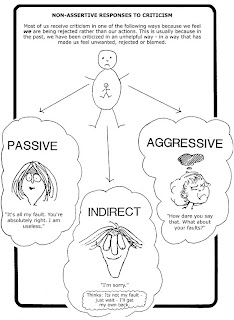
Characteristics of assertive behaviour

This type of behaviour involves standing up for your rights and expressing your thoughts and feelings directly and honestly in a way which respects the rights of others. The goal of assertiveness is to communicate clearly with each other. This allows us to express what we think whilst valuing the opinion of others and being open to exploring areas of conflict. Characteristics of assertiveness include:

  • Really listening
  • Firm but relaxed voice
  • Direct eye contact
  • Erect, balanced, open body stance
  • Voice appropriately loud for the situation
  • "I" statements (e.g. "I like", "I want", "I don't like")
  • Cooperative phrases (e.g. "What are your thoughts on this?")
  • Clear statements of interest (e.g. "I would like to...")

Reblog this post [with Zemanta]

Tuesday, October 14, 2008

Five Ways of Boosting Up Your Self-Esteem

Many people harbor negative self-image for a lot of reasons. There are those whose depressed images have been keeping them off the mark since childhood. With such low self-esteem, virtually every part of their lives, relationships, career and health are negatively affected.

Boosting one’s self-esteem is essentially a matter of transforming your views about oneself and one’s life. Cognitive behavior therapy techniques are especially helpful in changing unhealthy thinking and behavior patterns. Based on the idea that your feelings and behavior result from how you think about yourself and your life, these techniques can help you recognize, challenge and ultimately replace negative thoughts or inaccurate beliefs with more positive, realistic ones.

Based on cognitive behavior therapy principles, there are five steps toward achieving healthy self-esteem. As you undergo these five steps, keeping a record of your thoughts, experiences and observations in a journal may help you draw on these steps more successfully.

Recognize disturbing conditions or situations

Identify what conditions or situations about your life that you find disturbing and that seem to shrink your self-esteem. You may aspire to change aspects of your personality or behavior, such as a fear of doing something in front of people, frequently becoming angry or always expecting the worst. You may be besieged with depression, a disability or a change in life circumstances, such as the death of a loved one, a lost promotion or children leaving home. Or you may wish to improve your relationship with another person, such as a spouse, family member or co-worker.

Pay attention to beliefs and thoughts

Once you've recognized and acknowledged disturbing conditions or situations, become aware of your thoughts related to them. This includes your self-talk as well as your interpretation of what a situation means and your beliefs about yourself, other people and events. Your thoughts and beliefs may be positive, negative or neutral. They may be rational — based on reason or facts — or irrational — based on false ideas.

Identify unconstructive or erroneous thinking

Your beliefs and thoughts about a condition or situation affect your reaction to it. Unconstructive or erroneous thoughts and beliefs about something or someone can activate unhealthy physical, emotional and behavioral responses, including:

Physical responses, such as a stiff neck, sore back, racing heart, stomach problems, sweating or change in sleeping patterns.

Emotional responses, such as difficulty concentrating or feeling depressed, angry, sad, nervous, guilty or worried.

Behavioral responses, such as eating when not hungry, avoiding tasks, working more than usual, spending increased time alone, obsessing about a situation or blaming others for your problems.

Confront unconstructive or erroneous thinking

Your initial thoughts may not be the only possible way to view a situation. So test the accuracy of your thoughts. Ask yourself whether your view of a situation is consistent with facts and logic or whether there might be other explanations.

You may not easily recognize inaccuracies in your thinking. Most people have automatic, long-standing ways of thinking about their lives and themselves. These long-held thoughts and beliefs feel normal and factual to you, but many are simply opinions or perceptions.

These kinds of thought patterns tend to erode self-esteem:

All-or-nothing thinking. You see things as either all good or all bad. For example, "If I don't succeed in this job, I'm a total failure."

Mental filtering. You see only negatives and dwell on them, distorting your view of a person or situation or your entire life. For example, "I made a mistake on that report and now everyone will realize I'm a failure."

Converting positives into negatives. You reject your achievements and other positive experiences by insisting that they don't count. For example, "My date only gave me that compliment because he knows how bad I feel." "I only did well on that test because it was so easy."

Jumping to negative conclusions. You reach a negative conclusion when little or no evidence supports it. For example, "My friend hasn't replied to my e-mail, so I must have done something to make her angry."

Mistaking feelings for facts. You confuse feelings or beliefs with facts. For example, "I feel like a failure, so I must be a failure." No matter how strong a feeling is, it isn't a fact.

Self put-downs. You undervalue yourself, put yourself down or use self-deprecating humor. This can result from overreacting to a situation, such as making a mistake. For example, "I don't deserve anything better." "I'm weak, stupid or ugly."

Modify your thoughts and beliefs

The final step is to replace or change the negative or inaccurate thinking you've identified with accurate thoughts and beliefs. This enables you to discover helpful ways to muddle through and give your self-esteem a boost.

This step can be difficult. Thoughts often occur spontaneously or automatically, without effort on your part. It can be hard to control or turn off your thoughts. Thoughts can be very powerful and aren't always based on logic. It takes time and effort to learn how to recognize and replace distressing thoughts with accurate ones.

These strategies may help you approach situations in a healthy way:

Use hopeful statements. Be kind and encouraging to yourself. Pessimism can be a self-fulfilling prophecy. That is, if you think your presentation isn't going to go well, you may indeed stumble through it. Try telling yourself things such as, "Even though it's tough, I can handle this situation."

Forgive yourself. Everyone makes mistakes. Mistakes aren't permanent reflections on you as a person. They are isolated moments in time. Tell yourself, "I made a mistake but that doesn't make me a bad person."

Avoid 'should' and 'must' statements. If you find that your thoughts are full of these words, you may be setting unreasonable demands on yourself — or others. Removing these words from your self-talk can give you and others more realistic expectations.

Focus on the positive. Think about the good parts of your life. Ask yourself, "What other things have gone well recently?" "What personal skills do I have that have helped me cope with challenging situations in the past?"

Relabel upsetting thoughts. Having negative thoughts doesn't mean you must choose to react negatively. Instead, think of them as signals to use new, healthy thinking patterns. Ask yourself, "Which of my strengths can help me respond in a constructive way?" "What can I think and do to make this less stressful?"

Encourage yourself. Give yourself credit for making positive changes. Treat yourself as well as you'd treat a loved one. Tell yourself, "I did a good job on the presentation. It may not have been perfect, but my colleagues said it was good."

Living out in practice, these steps may come more effortlessly to you. You'll be better able to recognize the thoughts and beliefs that are contributing to your low self-esteem. Since self-esteem can ebb and flow over time, you may want to repeat these steps, especially if you begin to feel down on yourself again. Keeping a journal or daily log can help you trace trouble spots over time.

Achieving a balanced, accurate view of yourself and accepting your value as a human being may help you feel happier and more confident. And that may affect or influence others, too, including your family or friends or co-workers.